Tuesday, September 4, 2007
The Power of Simplicity

Sunday, September 2, 2007
Appendix
Research
To improve the research aspect of my blog I could have chosen a different classic experiment. I did however, begin with the famous blue eyed experiment by Jane Elliot’s. I soon discarded this study, as like Clark’s experiment there was also little academic information. I found this surprising as this study is highly known. I could have also discarded Clark’s experiment, but I felt it acted as a powerful example of ‘research’ results that had been accepted by society due to publicity.
Written Expression
Before this, I had never conducted a readability score, thus this concept is very foreign to me. I feel my scores show that I have a lot of improvement to make on my expression. I need to work on breaking my sentences down into simpler concepts, ensuring I still make each point specifically. This is a valuable learning curve for me as it has made me aware of these aspects I could focus on.
My readability analysis:
Flesch-Kincaid Reading Ease: 21
Ideally, web page text should be around the 60 to 80 mark on this scale. The higher the score, the more readable the text.
Flesch-Kincaid Grade Level: 16
Ideally, web page text should be around the 6 to 7 mark on this scale. The lower the score, the more readable the text.
Gunning-Fog Index: 24
Ideally, web page text should be between 11 and 15 on this scale. The lower the score, the more readable the text. (Anything over 22 should be considered the equivalent of post-graduate level text).
Notes:Average syllables per word: 1.91
Average words per sentence: 23.9
Word count: 1,486
Online Engagement
List of my contributions:
https://www.blogger.com/comment.g?blogID=7043136964552978894&postID=8955060910511648598
https://www.blogger.com/comment.g?blogID=7043136964552978894&postID=320055981652605985
https://www.blogger.com/comment.g?blogID=39933033313722734&postID=8073953344682434148
List of my blogs:
http://becblair.blogspot.com/2007/07/tester.html
http://becblair.blogspot.com/2007/07/nazi-germany-experiments.html
http://becblair.blogspot.com/2007/07/psych-experiments-and-their-link-to.html
http://becblair.blogspot.com/2007/08/unethical-psychological-experiments.html
http://becblair.blogspot.com/2007/08/kiri-davis-girl-like-me.html
http://becblair.blogspot.com/2007/08/classic-experiments-table.html
http://becblair.blogspot.com/2007/08/experiment-locations-reply-to-james.html
http://becblair.blogspot.com/2007/09/classic-experiments-of-aggression.html
http://becblair.blogspot.com/2007/09/albert-bandura-bobo-doll.html
http://becblair.blogspot.com/2007/09/stanley-milgram.html
http://becblair.blogspot.com/2007/09/modelling-of-agression.html
http://becblair.blogspot.com/2007/09/sherifs-robbers-cave-experiment.html
http://becblair.blogspot.com/2007/09/appendix.html
Appendix B
Links of interest
Milgram - http://www.stanleymilgram.com/quotes.php
Clark - http://becblair.blogspot.com/2007/08/kiri-davis-girl-like-me.html
Bandura - http://becblair.blogspot.com/2007/09/albert-bandura-bobo-doll.html
Sherif - http://www.age-of-the-sage.org/psychology/social/sherif_robbers_cave_experiment.html
Appendix C
The Drinking Water Problem: The first superordinate goal to be introduced and involved the boys fixing their water supply which required cooperation by both groups. The groups worked together for over 45 minutes to reach a obtain a singular goal.
The Problem of Securing a Movie: The next superordinate goal to be introduced was a feature-length movie. The two groups had to pool their money with the camp in order to purchase the movie.
Other superordinate goals included the joint use of a tug-of-war-rope on a partly cut-through dangerous tree.
Sherif's Robbers Cave Experiment
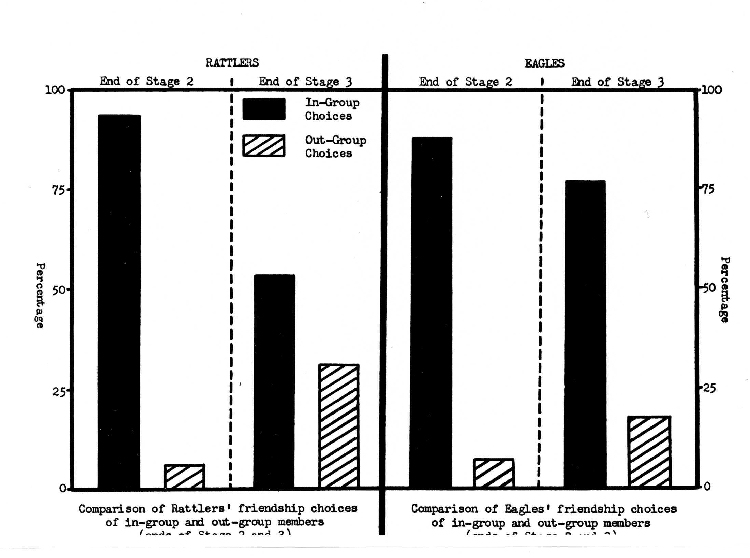
Comparison of Rattlers' (left) and Eagles' (right) friendship choices of in-group and out-group members at the end of Stage 2 and Stage 3.
Stage 1- experimental formation of the in-group
Stage 2- production of negative attitudes toward the out-group
Stage 3- reduction of inter-group hostility

Stanley Milgram...
The Classic Experiments of Aggression, Prejudice and Stereotypes in Social Psychology
Introduction
Classic social psychology experiments are used to reveal key elements of aggressive behaviour, prejudice and stereotyping. Prejudice is the ‘unfavourable attitude towards a social group and its members’ and is displayed in the ‘lost letter’ experiment conducted by Stanley Milgram (Vaughan & Hogg, 2002, p. 256). A stereotype is a ‘widely shared and simplified evaluative image of a social group and its members’ and is exhibited in the ‘doll test’ conducted by Clark and Clark (Vaughan & Hogg, 2002, p. 259). Lastly, aggression is ‘behaviour that is intended to injure someone physically or psychologically’ (Breckler, 2006). The ‘bobo doll’ experiment conducted by Albert Bandura demonstrates the ability for children to learn aggressive behaviours from models, and the ‘Robbers Cave’ experiment displays the initiation of aggressive behaviour and also the development of prejudice. Each classic experiment carries strengths and weaknesses and raises implications; however some studies are more soundly based in psychological theory and experimental validity.
Clark used his results to show ‘that school segregation was distorting the minds of Black youngsters to the point of making them self-hating’ (Douglas, 2006). This study has been criticised for being famous only for the reference in the court case as opposed to the experimental value of the work. Criticisms of the study include a lack of theory and control of variables. An African American husband and wife team conducted the studies, and thus their desired outcomes of wanting to prove African Americans were negatively stereotyped may have skewed the results. This study presents a shock factor in the results and thus it is a well-known experiment; however the results lack experimental weight and therefore I have ranked it in fourth position.
Milgram’s famous ‘lost letter’ experiment is a technique to examine the prejudice toward socially undesirable groups. Milgram dispersed self-addressed and stamped envelopes and counted the number of ‘lost letters’ that were mailed (Milgram 1977). The envelopes were addressed to; medical research associates, friends of the Communist party, friends of the Nazi party and Mr. Walter Carnap (Milgram, Mann & Harter, 1965). The letters were dispersed in the streets, under car windscreen wipers, in telephone booths and in shops. Those who found the letters could either; post it, ignore it or actively destroy it (Shotland & Berger, 1970). Milgram distributed 400 letters, 100 addressed to each of the groups, and as expected more people mailed letters addressed to the socially desirable groups (those addressed to medical associates and the personal letter) than to the socially undesirable groups (Nazi party and Communist party) (Milgram, 1977).
The rate of return was the focus of the study and was highest for the Medical research associates with 72%, 71% for the personal letter and 25% each for the friends of the Nazi party and friends of the Community party (Milgram, Mann & Harter, 1965). However, this study has limitations as only the return rate can be assessed and it only works for strong issues (Milgram, 1969). This study is significant as it allows prejudice to be examined through an everyday task, without people realising that their prejudice is being examined, thus making it powerful and my number three.
In 1961, Bandura conducted the famous ‘bobo doll’ study, ‘transmission of aggression through imitation of aggressive models’ (Bandura, Ross & Ross, 1961). This study was based on the social learning theory which proposes that ‘humans learn many kinds of responses, including aggressive ones, by observing other people’ (Breckler, 2006, p. 450). The 72 participants were recruited from the Stanford University Nursery School and ranged in age from 37 to 69 months. Three groups were created; an aggressive experimental group, a nonaggressive experimental group and a control group. The groups were further divided by gender of the participants and gender of the models. The participants were brought into a room and placed in the corner to play; in the experimental groups an actor was brought in who played on the other side of the room (Bandura, Ross & Ross, 1961). The participants were left to observe the actor who played independently, acting either aggressive or nonaggressive. The participants were then led to another room where their behaviour was observed and measured in terms of imitation of physical aggression, verbal aggression and nonaggressive verbal responses.
Bandura found that the exposure of subjects to aggressive models increased the probability of aggressive behaviour, and these subjects’ scores were significantly higher than those of the nonaggressive and control groups (Bandura, Ross & Ross, 1961). This study demonstrates that young children model the aggressive behaviour of those around them; this is important as it reveals that children notice and replicate others’ actions. By reducing the exposure to aggressive models, the aggressive acts displayed by a child may be minimised. These findings were replicated in other studies of modelling by Bandura including the modelling of aggression through television, cartoons and also the implications of rewards and punishment for aggressive acts (Isom, 1998; Bandura, 1971; Grusec, 1992). This study I have placed as my number two as it is both a valid and a reliable study, and produces great implications for the behaviour of those around children.
Prejudice against the out-group developed first, then verbal aggression and then aggressive actions such as burning each other’s flags. The hostility was only overcome by the use of superordinate goals to construct a cooperative nature between the two groups (Sherif, Harvey, Jack White, Hood & Sherif, 1961; Fine, 2004). Sherif and colleagues had created a ‘microcosm of an intolerant and warring world’ and the implications showed that ‘two groups can exist as long as they develop meaningful joint goals’ (Aron & Aron, 2007). This study is significant in that it shows that prejudice and aggression can easily develop between people of very similar ethnic, religious and socio-economic status when placed in a situation of realistic conflict. Sherif brings together psychological theory and elements of both prejudice and aggression and thus I have ranked it as the most significant classic experiment.
The classic social psychology experiments are revealing in regards to the development and existence of stereotypes, prejudice and aggression. Prejudice and stereotyping are particularly difficult to assess due to social desirability, people are not often willing to express their discriminatory views of others. The ‘lost letter’ experiment by Milgram enables an easy examination of the prejudice by hiding the motivation behind the lost letter. The assessment of the stereotypes already in place with young African American children was conducted by Clark. This study, though having little experimental basis, revealed the stereotype of Black as bad and White as nice. Albert Bandura, also focused on young children, demonstrating the early behavioural modelling of aggression. The study of children is important, showing that children are in a critical period for modelling the thoughts and behaviours demonstrated by those around them. Lastly, the Robbers Cave experiment reveals that competition for limited resources can easily produce prejudice and aggression in those that are relatively similar in age, socioeconomic status, religious views and ethnic identity. This study is highly relevant to modern society and thus it is my first choice. Each of these social psychology experiments has been classified as a ‘classic experiment’ and each is important on the basis of the implications produced.
Aron, A., & Aron, E. (2007). Chutzpah: Social Psychology takes on the big issues. In J. A. Nier (Ed.), Taking sides: clashing views in Social Psychology (pp. 30- 49). Dubuque, Iowa: McGraw-Hill.
Bandura, A. (1971). Analysis of modeling processes. In A. Bandura (Ed.), Psychological modeling: conflicting theories (pp. 1-62). Chicago: Aldine Atherton.
Bandura, A., Ross, D., & Ross, S. A. (1961). Transmission of aggression through imitation of aggressive models. Journal of Abnormal and Social Psychology, 63, 575-582. Retrieved August 8, 2007, from http://psychclassics.yorku.ca/Bandura/bobo.htm
Breckler, S. J., Olson, J. M., & Wiggins, E. C. (2006). Social psychology alive. Belmont: Thomson/Wadsworth.
Clark, K. B., & Clark, M. P. (1940). Skin colour as a factor in racial identification and preference in Negro children. Journal of Social Psychology, S.P.S.S.I. Bulletin, 11, 159-169. Retrieved August 28, 2007, from http://psychclassics.yorku.ca/Clark/Skin-color/
Douglas, C. (2006). What the bluest eye knows about them: culture, race, identity. American Literature, 71, 1, 141. Retrieved August 28, 2007, from http://americanliterature.dukejournals.org/cgi/reprint/78/1/141
Fine, G. A. (2004). Forgotten classic: the Robbers Cave experiment. Sociological Forum, 19, 4, 663-666.
Grusec, J. E. (1992). Social learning theory and developmental psychology: the legacies of Robert Sears and Albert Bandura [Electronic Version]. Developmental Psychology, 28, 5, 776-786.
Isom, M. D. The social learning theory. (1998, November 30). Retrieved August 9, 2007, from http://www.criminology.fsu.edu/crimtheory/bandura.htm
Milgram, S. (1969). Comment on ‘a failure to validate the lost letter technique.’ Public Opinion Quarterly, 33, 2, 263.
Milgram, S. (1977). The individual in a social world. New York: McGraw-Hill.
Milgram, S., Mann, L., & Harter, S. (1965). The lost-letter technique: a tool of social research. Public Opinion Quarterly, 29, 3, 437.
Powell-Hopson, D., & Hopson, D. S. (1988). Implications of doll colour preferences among black preschool children and white preschool children. The Journal of Black Psychology, 14, 2, 57-63.
Sherif, M., Harvey, O. J., Jack White, B., Hood, W. R., & Sherif, C. W. (1961). Intergroup conflict and cooperation: the Robbers Cave experiment. Classics in the history of psychology. Retrieved August 28, 2007, from http://psychclassics.yorku.ca/Sherif/
Shotland, R. L., & Berger, W. G. (1970). A validation of the lost-letter technique. Public Opinion Quarterly, 34, 2, 278-281.
Vaughan, G. M. & Hogg, M. A. (2002). Introduction to social psychology (3rd Ed). New South Wales: Pearson Education.
Wessells, M. (1994). The Robber’s Cave experiment. UNESCO Sources, 62, 10.
‘With an even hand’ Brown v. Board at fifty. (2004, October 18). Retrieved August 9, 2007, from The Library of Congress: http://www.loc.gov/exhibits/brown/brown-brown.html


